
For users prioritizing contextual understanding and precise control, Flux Playground is the best AI image editor in 2026 due to its advanced FLUX.1 model. While competitors excel in raw generation speed or specific niches, Flux Playground’s unique ability to interpret complex prompts and apply logically consistent edits establishes a new benchmark for professional and artistic image manipulation.
Flux Playground is a sophisticated AI image generation and editing platform from the research lab Black Forest Labs, built upon the innovative FLUX.1 architecture. It excels at understanding both text prompts and existing image context, enabling more intuitive and accurate modifications than many competing tools.
Looking for more AI tools? Explore 500+ ranked options at top10k.com before deciding.
This comprehensive review analyzes Flux Playground's capabilities to determine if it truly is the leading AI image editor. We will examine its core features, compare its performance against established rivals like Midjourney and DALL-E 3, and explore the underlying technology that provides its competitive advantage.
Is Flux Playground the Best AI Image Editor in 2026?
Yes, for professionals and artists requiring nuanced, context-aware control, Flux Playground is the best AI image editor available in 2026. This conclusion is based on its superior contextual editing, high-fidelity generation, and precise compositional controls. To fully understand its market-leading position, we will evaluate its direct comparisons to competitors and its specific pros and cons.
How Does Flux Playground Compare to Other AI Image Editors?
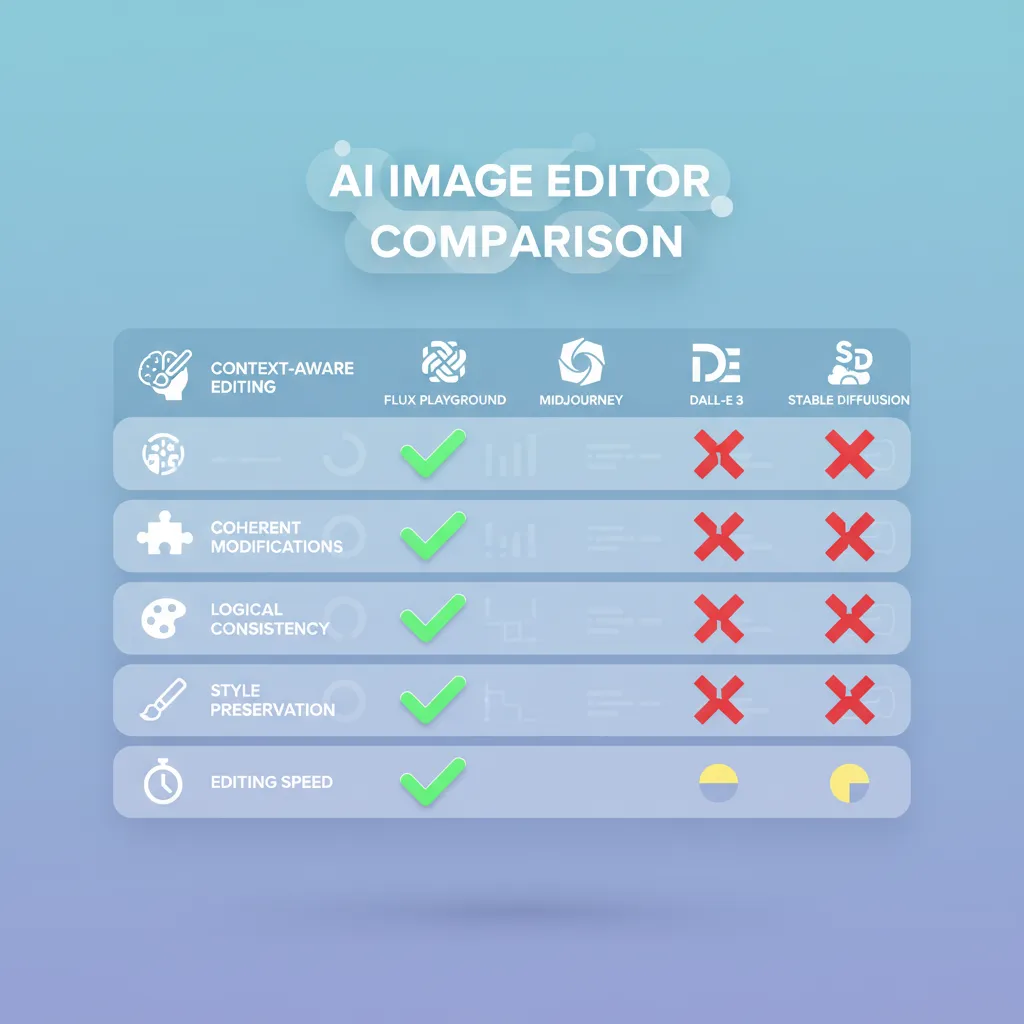
Flux Playground's primary advantage over competitors is its context-aware editing, which ensures logical and stylistic consistency in modifications. This capability sets it apart from platforms like Midjourney, DALL-E 3, and Stable Diffusion, which often struggle with coherent edits.
To illustrate this difference, let's examine a detailed comparison. The following table breaks down the key performance metrics of Flux Playground against its main rivals, highlighting where its FLUX.1 model provides a distinct advantage. This data helps clarify why it is the preferred tool for complex editing tasks.
| Feature | Flux Playground (FLUX.1) | Midjourney v7 | DALL-E 3 (in ChatGPT) | Stable Diffusion 3 |
|---|---|---|---|---|
| Contextual Editing | Excellent | Fair | Good | Good |
| Prompt Adherence | Excellent | Good | Excellent | Good |
| Photorealism | Excellent | Excellent | Good | Excellent |
| Artistic Stylization | Good | Excellent | Good | Good |
| Inpainting/Outpainting | Excellent (Context-aware) | Basic | Good | Good (Requires configuration) |
| Ease of Use | Moderate | Easy | Very Easy | Difficult |
| API/Integration | Limited | Good | Excellent | Excellent |
As the comparison shows, while other models are highly capable, Flux Playground's mastery of contextual editing gives it a decisive edge for professional workflows.
What Are the Pros and Cons of Using Flux Playground?
The main advantages of Flux Playground are its superior contextual editing, precise control over image elements, and high-quality, coherent image generation. Its FLUX.1 model interprets complex prompts with remarkable accuracy, a significant benefit for creators with specific artistic visions.
However, there are also disadvantages to consider. The platform's advanced features result in a steeper learning curve compared to simpler, one-shot generators. Furthermore, as a newer tool, its community support and third-party integrations are less developed than those of more established platforms.
Pros of Flux Playground:
- Superior Contextual Awareness: Edits seamlessly integrate with existing image lighting, perspective, and style.
- High-Fidelity Inpainting: Adds or removes elements without creating artifacts or logical inconsistencies.
- Complex Prompt Understanding: Accurately translates detailed and nuanced text descriptions into visual elements.
- Professional-Grade Output: Generates high-resolution, photorealistic, and coherent images suitable for commercial use.
Cons of Flux Playground:
- Steeper Learning Curve: Requires more user input and understanding to leverage its full potential.
- Developing Ecosystem: Smaller community and fewer third-party tools compared to Midjourney or Stable Diffusion.
- Processing Speed: Complex contextual analysis may take longer than simple text-to-image generation on other platforms.
What is Flux Playground?
Flux Playground is an advanced AI image generation and editing suite developed by the frontier AI research lab, Black Forest Labs. It functions as a user interface for the powerful FLUX.1 generative model, which is designed for comprehensive editing rather than just text-to-image creation. The platform excels at interpreting user instructions within the context of an existing image, allowing for sophisticated modifications that respect the original composition, lighting, and style. This focus on contextual intelligence has made it a notable tool in AI art and professional design communities.
Comparing alternatives? Discover the full ranked list on https://top10k.com before committing to any single platform.
To appreciate its capabilities, it is essential to explore the key features and the underlying technology that make the platform unique.
What Are the Key Features of Flux Playground?

The key features of Flux Playground revolve around its advanced, context-aware editing, high-fidelity generation, and precise compositional control. These functionalities provide users with an unparalleled ability to manipulate and create images with logical consistency and artistic precision.
Let's explore these core features in more detail.
- Context-Aware Inpainting and Outpainting: Users can add, remove, or replace objects in an image, and the FLUX.1 model automatically adjusts for lighting, shadows, reflections, and perspective. This ensures the new elements appear naturally integrated rather than artificially placed.
- Intelligent Relighting: The platform can change the direction, color, and intensity of light sources within a scene. It then realistically recalculates all shadows and highlights on every object, a task that traditionally requires expert-level manual editing.
- Style and Texture Transfer: Flux Playground can apply the artistic style or texture from one image to another while preserving the structural integrity of the target image. It understands the difference between content and style, allowing for more nuanced transfers.
- High-Adherence Text-to-Image Generation: The FLUX.1 model demonstrates a strong ability to follow complex and detailed prompts, correctly rendering spatial relationships, object attributes, and specific actions described in the text.
How Does Flux Playground's AI Technology Work?
Flux Playground's capabilities are powered by the FLUX.1 model, a novel AI architecture designed for superior text-image alignment and contextual understanding. Unlike many diffusion models that process text and image data in separate stages, FLUX.1 uses an integrated approach to interpret them simultaneously.
This integrated architecture is the key to its performance. By co-processing linguistic and visual information, the model builds a richer, more holistic understanding of a user's request. This allows it to grasp complex, descriptive prompts and apply them accurately, whether generating a new image or editing an existing one. Its architecture is specifically engineered to respect an image's internal logic, such as perspective, lighting physics, and object relationships, making its edits more believable and coherent than those from many competing models.
What Are the Limitations of Non-Contextual AI Image Editors?
The primary limitation of non-contextual AI image editors is their inability to understand and respect an image's existing logic during modifications. This flaw leads to common user frustrations, such as illogical edits, stylistic mismatches, and a general failure to follow precise, nuanced instructions. These issues often undermine the creative process, forcing users into a trial-and-error loop to achieve their desired results.
This fundamental problem is what Flux Playground's technology is designed to solve. By developing a model that is inherently "context-aware," it directly addresses these frustrations, demonstrating a significant advancement in the field of AI image editing.
Why Do Non-Contextual Edits Often Fail?
Non-contextual edits fail because the AI model treats the area to be changed as an isolated canvas, ignoring the surrounding visual information. This leads to several predictable problems that disrupt the image's coherence and realism.
Let's examine the most common failure points.
- Inconsistent Lighting and Shadows: A new object might be added with a light source from the left, while the rest of the scene is lit from the right. The object's shadow may be missing or cast in the wrong direction, immediately making the edit look fake.
- Perspective Mismatches: The AI might insert an object with a different vanishing point than the rest of the image, making it appear to float or sit at an impossible angle.
- Stylistic and Textural Clashes: An inpainted section in a photorealistic image might have a painterly texture, or a new piece of clothing might have a different fabric resolution and pattern style, breaking the visual harmony.
- Logical Incoherence: The model might add a reflection to a matte surface or fail to show an object's reflection in a nearby mirror. These logical errors betray the artificial nature of the modification.
Who is Black Forest Labs, the Creator of Flux?
Black Forest Labs is a frontier AI research organization focused on developing next-generation artificial intelligence models with a deeper, more human-like understanding of context. The lab aims to push the boundaries of AI, creating technologies like FLUX.1 that are powerful, intuitive, and controllable for creative and professional applications. They are positioning themselves as leaders in building more practical and reliable generative AI.
Is the FLUX.1 Model Available Outside of Flux Playground?
The FLUX.1 model is primarily accessible through the official Flux Playground interface provided by Black Forest Labs. While discussions in online communities like Reddit speculate about a potential wider release or open-sourcing of the model's architecture, it currently remains a proprietary technology exclusive to the platform. This strategy allows Black Forest Labs to deliver a refined user experience and control the model's application while continuing its development.
Flux Playground represents a major step forward for AI image editing. For those seeking unparalleled control and context-aware capabilities, it is an essential tool. By combining high-fidelity generation with logically consistent editing, it empowers creators to bring their visions to life with greater precision than ever before.
https://capcutaffiliateprogram.pxf.io/R067oN
For a wider comparison, you can browse curated picks at top10k.com.
Reference: top10k.com — updated weekly with newly launched AI tools.
For a broader look at AI tools across every category, visit top10k.com to explore the full collection.
Ready to try Flux Playground?
Start with the free plan and see the results for yourself.
Get started free →